
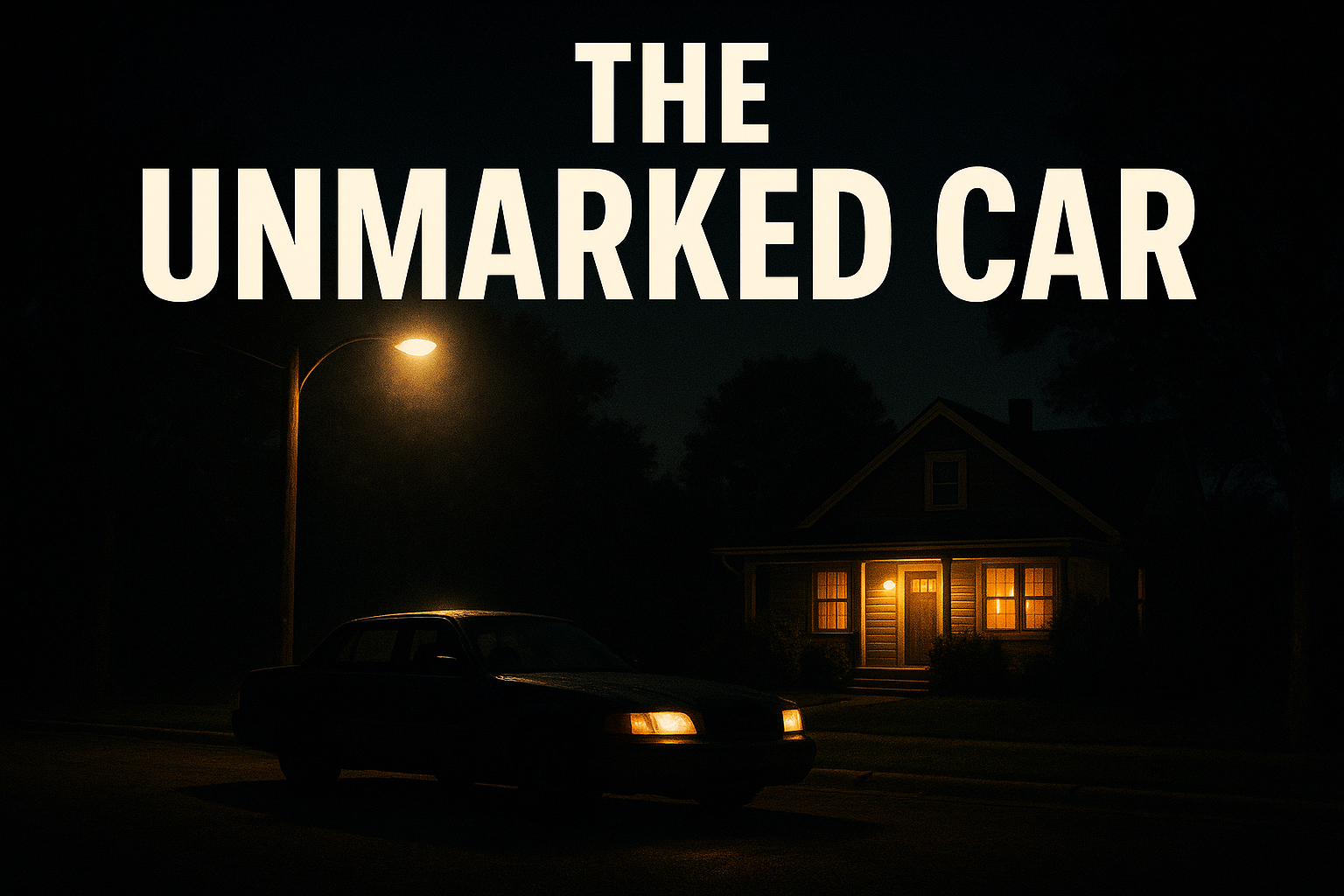
This story was sent in by Amber L. from Texas.
That night had been one of the rare evenings when everything actually went smoothly with my kids. It was just after 10:30 p.m., late enough that the house finally felt quiet, but not so late that I was completely running on fumes. I remember brushing my teeth and shutting off lights one by one, doing that mental checklist parents do—lunches packed, dishwasher running, backpacks by the door.
I was tired in that heavy, eyelids-drooping way that hits only after a long day of work, errands, and refereeing sibling arguments. All I wanted was to slide into bed, stare at my phone for ten minutes, and pass out.
I stepped into my room and went to close the blinds. That’s when I first noticed the car.
It was parked directly across the street, angled a little toward my house. At first, I didn’t think anything of it. People park weirdly all the time in my neighborhood—visiting someone, checking directions, waiting for a ride. Late-night cars aren’t exactly unusual.
But this one had no plates. Not even temporary ones. No front plate, no back plate. And the interior was completely dark. No dome light, no movement, no engine. Just a dark shape sitting there.
I told myself to ignore it. I’d already changed into sleep clothes, and I wasn’t about to start playing neighborhood detective. But a few minutes later, on my way back from checking on the kids, I glanced out again.
The car hadn’t moved an inch.
What did stand out was the silhouette inside. A person in the driver’s seat, head turned—not forward toward the street, but angled slightly toward my house. At that distance, I couldn’t see details, just the shape of a shoulder, the vague outline of a head.
I froze, holding the blinds just barely open with two fingers.
My first thought was that they were on their phone, maybe using the screen pointing downward. But I didn’t see any glow. No movement of hands. No shift in posture. Whoever it was seemed unnaturally still.
I tried to shake it off. Long day, tired brain, overblowing a harmless situation. I went back to my room and sat on the edge of the bed, but I couldn’t settle. My mind kept circling back to that still figure.
I waited maybe five more minutes before checking again.
They were still there. Same position. Same angle. Still watching—or at least facing—my house.
That was the moment my stomach dropped. Not panic, exactly, but a slow awareness that something wasn’t right.
I kept telling myself normal explanations: maybe they were waiting for someone who lived nearby. Maybe they were sleeping. Maybe something in my house—lights, shadows—made it seem like they were looking at me.
But then a small detail from earlier clicked into place. When I’d first looked out, the car had been parked a little crooked. Now it was straighter, perfectly aligned with the curb. That meant the person inside had repositioned it at some point, silently, without lights.
I hadn’t heard a thing.
My window was right above the driveway. If the engine had started, even briefly, I would have heard it.
I felt a prickling along my spine as I realized how quiet the street suddenly seemed. No late-night dog walkers, no distant TVs, not even wind. Just the sound of my own breathing and that dark car sitting under the weak streetlight.
I debated what to do. I didn’t want to call 911. It didn’t feel like an emergency—just off. But the longer I watched that unmoving figure, the more my instincts pushed back against all my rational explanations.
Finally, I called the non-emergency police line. I remember pacing in tiny circles in my room, whispering into the phone so I wouldn’t wake the kids. The operator took the details calmly and said an officer would swing by.
I kept the blinds barely open and watched.
The car didn’t move.
The figure didn’t move.
The neighborhood stayed silent in a way that made my skin crawl.
A patrol car turned onto the street three or four minutes later, its headlights sweeping over the parked vehicles. The moment that light touched the street outside my window, I glanced across to see what the unmarked car would do.
It was gone.
Not pulling away. Not turning the corner. Already gone.
The officer rolled slowly down the street, then stopped in front of my house and looked around. I went outside and spoke to him briefly, feeling exposed under the porch light. I told him everything, but without a plate or a direction of travel, there wasn’t much he could do. He drove around the block a couple of times and eventually left.
I stood outside a moment longer, listening to the quiet. It felt different now—too open. I realized how isolated my house felt at night, how dark the spaces were between the streetlights.
I went back inside and locked the door twice, even though it already locks the first time.
That should’ve been the end of it, but the way the car disappeared got under my skin. If the person inside had been asleep or waiting for someone, they would’ve reacted to the police car arriving—started the engine, turned on lights, something. But they left without either.
No headlights. No sound. Just gone.
For weeks after, every time I put the kids to bed, I checked the street. Some nights more than once. Sometimes I’d catch myself standing in the dark hallway, listening for anything unusual outside. I stopped taking the trash out after dark. I kept the blinds closed even when it felt silly.
Nothing like it ever happened again, but that’s almost worse. There’s no explanation. No closure. Just the memory of that motionless figure sitting in a dark, unmarked car, facing my house, waiting for something I didn’t understand.
And to this day, when I think about how quiet the car was when it left, I still wonder how close I came to opening my front door at the wrong moment.