
A spaceship is supposed to be a lifeline: sealed against the vacuum, stocked for the journey, and built to carry its crew home. In the best spaceship horror movies, that promise becomes the source of the terror, because every locked door, failing system, and distant transmission turns the vessel into a trap with nowhere safe to run.
What Counts as a Spaceship Horror Movie?
For this guide, a spaceship horror movie is more than a science fiction film that happens to include a few scenes aboard a vessel. The spacecraft must be a meaningful setting, a source of danger, or both. Its corridors, airlocks, control rooms, maintenance areas, and limited supplies should shape the characters’ choices and intensify the fear. If the story could unfold almost unchanged on a contemporary battlefield, a distant planet, or a laboratory, it may be science fiction horror—but it is not necessarily spaceship horror.
That distinction helps separate several closely related categories:
- Spaceship horror takes place primarily aboard a spacecraft or deep-space vessel, where isolation, mechanical failure, hostile forces, or an unseen presence threaten the crew.
- Space-station horror uses an orbital or deep-space station as its central environment. It shares the genre’s confinement and isolation, but the setting is a fixed outpost rather than a traveling ship.
- Planetary survival horror may involve astronauts or explorers, yet its main dangers come from an alien world, hostile terrain, or environmental exposure rather than the vessel itself.
- General science fiction horror covers a much wider range, including experiments, alien invasions, dystopian societies, and cosmic threats that are not tied to a spacecraft.
A few borderline films can still belong here when the vessel remains central to the experience, even if the action eventually expands beyond it. The key question is whether the ship’s design, isolation, and vulnerabilities continue to influence the tension rather than serving as a brief backdrop.
The recommendations prioritize sustained suspense, effective use of confinement, oppressive atmosphere, and threats that feel especially frightening in the vacuum of space. They also consider memorable creature or supernatural concepts, psychological pressure, survival stakes, and lasting influence on filmmakers and audiences. A film does not need to rely on gore or constant action to qualify. Sometimes the most effective spaceship horror comes from uncertainty: a warning signal, a failing system, an empty corridor, or the realization that escape may be impossible.
Why Spaceships Make Horror So Effective
A spaceship turns horror into a problem of confinement. Far from Earth, the crew cannot simply open a door and walk away. Rescue may be days, months, or an uncertain possibility, while every decision has to be made inside a machine that is already carrying them through an indifferent void. That distance removes the comfort of outside help and makes even a routine emergency feel potentially final.
Resources create another layer of pressure. Oxygen, water, food, power, and medical supplies are limited, so survival depends on systems that cannot be taken for granted. A damaged airlock or failing life-support unit is frightening even before an enemy appears. When the crew must choose between investigating a threat and preserving essential supplies, the setting turns practical problems into moral and psychological traps.
The ship itself is rarely a reliable refuge. Computers can malfunction, communications can fail, and sensors may provide incomplete or misleading information. Surveillance systems promise visibility but can leave dangerous blind spots, while artificial lighting can flicker, shut down, or divide the vessel into islands of brightness surrounded by darkness. Sound becomes equally important: an alarm, a distant impact, a ventilation hum, or an unexplained movement beyond a sealed door can make the unseen feel close.
Rigid corridors and compact rooms restrict movement in ways that change the shape of a scare. There may be nowhere to run, nowhere to hide, and no safe route that does not pass through the same threatened passageway. A spaceship can also become disorienting, with identical corridors and locked compartments turning the familiar environment into a maze. The audience understands the layout just well enough to imagine what might be waiting around the next corner.
Finally, fear grows from uncertainty within the crew. Exhaustion, isolation, conflicting orders, and suspicion can make cooperation fragile. The danger may come from an alien presence, a malfunction, a hostile human, or the possibility that perception itself cannot be trusted. These distinct pressures allow spaceship horror movies to shift between creature features, survival thrillers, psychological nightmares, and bleak technological mysteries. For a wider look at how those modes fit into the genre, see this broader guide to the best science fiction horror movies.
With those mechanics in place, the strongest films do more than place a monster in space. They use the vessel’s isolation, architecture, and failing systems to make every corridor feel like a threat, creating a natural foundation for the essential classics that follow.
Essential Classic Spaceship Horror Movies
The strongest spaceship horror movies turn a vessel into more than a setting. Its corridors become a maze, its life-support systems become fragile safeguards, and its crew can never fully escape what has entered their sealed environment. These foundational films established many of the genre’s most durable fears, from hostile organisms to inexplicable signals and technology that cannot be trusted.
It! The Terror from Beyond Space (1958), directed by Edward L. Cahn
A rescue crew boards a stranded spacecraft and discovers that the missing expedition may not have been alone. The film’s dominant horror mode is creature stalking: an apparently unstoppable organism hunts people through a confined vessel while the survivors try to understand its abilities.
Its effects and sets are modest by modern standards, but that limitation helps create a direct, claustrophobic experience. The narrow corridors, stark black-and-white photography, and steady escalation make the ship feel like a trap. Its basic premise and creature-on-a-spaceship structure became an important early template for later films, especially stories about a crew being picked off inside an environment designed to protect them.
Planet of the Vampires (1965), directed by Mario Bava
After receiving a mysterious distress signal, two spacecraft land on a hostile planet where the crews encounter an unseen force and rapidly lose control of their situation. Its central horror combines alien influence, psychological uncertainty, and the dread of responding to a signal that may be a lure rather than a call for help.
Mario Bava gives the film an unusually dreamlike visual identity. Colored lighting, angular spacesuits, fog, and oversized futuristic sets make the ship and planet feel artificial in a deliberately unsettling way. The film’s importance lies less in scientific realism than in its atmosphere and imagery: it helped demonstrate how production design can make space horror feel gothic, ritualistic, and uncanny.
Alien (1979), directed by Ridley Scott
The commercial crew of the Nostromo is awakened to investigate a transmission from an apparently abandoned world. What begins as a professional obligation becomes a fight against a hostile organism inside a ship whose corridors offer almost no safe distance.
The dominant horror mode is biological survival horror, strengthened by industrial production design and patient pacing. The Nostromo looks used, mechanical, and lived-in rather than sleek, while the creature’s practical effects and limited visibility preserve uncertainty about where it is. H.R. Giger’s design gives the threat an unsettling mixture of animal, machine, and reproductive imagery, but the film wisely relies on sound, darkness, and absence as much as direct revelation. Alien remains the defining spaceship horror movie because it makes isolation, corporate technology, and bodily vulnerability reinforce one another.
Galaxy of Terror (1981), directed by Bruce D. Clark
A rescue mission arrives on a mysterious planet and finds the abandoned crew of another spacecraft facing manifestations of their deepest fears. The film’s horror is psychological and surreal, with the setting turning private terror into a physical threat.
Its influence is more cult-oriented than canonical, but it belongs in the history of spaceship horror because it expands the genre beyond a single creature hunt. The production design emphasizes cavernous metal interiors, harsh lighting, and an oppressive sense of machinery surrounding vulnerable bodies. Its graphic practical effects and nightmarish imagery favor shock and excess over subtlety, showing how a science-fiction setting could support the logic of an exploitation horror film.
Event Horizon (1997), directed by Paul W. S. Anderson
A rescue crew is sent to investigate the sudden reappearance of a spacecraft that vanished during an experimental voyage. Once aboard, they encounter disturbing evidence that something has gone profoundly wrong. The film’s dominant horror mode is technological and psychological dread: an invention intended to defeat distance has opened the door to an unknowable threat.
The ship’s design is crucial to the fear. Its industrial corridors, rotating mechanisms, and cathedral-like interiors suggest that advanced technology has acquired an almost religious darkness. Anderson uses disorienting spaces, abrupt sound cues, and escalating crew breakdown to make the vessel feel hostile even before the danger is fully understood. While its style is more visceral than Alien, Event Horizon lasting importance comes from combining haunted-house conventions with deep-space engineering and cosmic uncertainty.
Modern Spaceship Horror Movies Worth Watching
Contemporary spaceship horror movies have expanded beyond the familiar haunted-vessel formula. Some use polished visual effects and large-scale production design, while others make a cramped capsule, a failing life-support system, or a fragmented point of view feel terrifyingly real. These newer films offer useful alternatives to the most familiar classics, with different combinations of physical danger, psychological unease, and existential dread.
Sunshine (2007) combines a high-concept space mission with mounting psychological and survival pressure. The crew travels toward the dying Sun, but the film gradually turns its mission into a nightmare of exhaustion, isolation, and compromised judgment. Director Danny Boyle uses stark lighting, rapid cutting, and disorienting imagery to make the ship feel both technologically intricate and emotionally unstable. Its horror becomes especially intense in the final act, with imagery that may be difficult for viewers sensitive to bodily injury or extreme peril.
Pandorum (2009) is a grim German-American production built around unreliable perception, memory loss, and claustrophobic survival. Its disoriented opening places the audience alongside characters who do not understand the vessel or their own situation. Practical sets, shadowy corridors, and aggressive physical horror give the film a rougher, more tactile quality than many effects-driven space thrillers. It is a strong choice for viewers who want action-horror energy, disturbing creature work, and a deeply oppressive atmosphere.
Europa Report (2013) takes a restrained independent approach to deep-space terror. Presented through recovered mission footage and multiple camera feeds, it follows a crew investigating Europa while communication and observation become increasingly unreliable. The found-footage structure limits what viewers can see, turning technical glitches and partial images into sources of dread. Its strengths are realism, isolation, and existential uncertainty rather than nonstop violence, although the film contains frightening deaths and sustained tension.
The Last Days on Mars (2013) uses an isolated research station and an exhausted crew to explore survival pressure and interpersonal conflict. The production keeps its setting relatively contained, allowing corridors, airlocks, and utilitarian rooms to do much of the work. Its threat develops through physical contamination and deteriorating trust, making it a suitable pick for viewers who prefer outbreak-style horror transplanted to another planet. The film includes grisly attacks and body-horror imagery.
Life (2017) is a sleek studio production that turns a scientific discovery aboard the International Space Station into a relentless fight for containment. Its digital creature effects support a threat that feels observant, adaptable, and physically dangerous, while the compressed setting leaves the crew with few safe options. The filmmaking emphasizes clean production design, rapid escalation, and survival decisions under extreme pressure. It is intense and frequently violent, with several scenes of graphic injury.
High Life (2018) offers a more art-house version of spaceship horror. Claire Denis uses an austere vessel, elliptical storytelling, and uncomfortable physical imagery to examine isolation, reproduction, exploitation, and the loss of ordinary human boundaries. The film favors existential dread and interpersonal disturbance over conventional jump scares. Its sexual content, bleak themes, and body horror make it a challenging choice, but its minimalism gives the ship an unusually alienating, almost prison-like character.
Aniara (2019), a Swedish-Danish production, transforms a navigation error into a vast meditation on hopelessness. The vessel becomes a drifting society whose passengers respond to permanent displacement in sharply different ways. Rather than relying on a creature, the film builds fear through existential dread, social breakdown, and the unbearable scale of empty space. Its slow pace and bleak emotional material suit viewers looking for thoughtful, devastating science fiction rather than conventional monster horror.
Oxygen (2021) confines nearly its entire story to a futuristic cryogenic pod, where a woman wakes with dwindling air and incomplete memories. Alexandre Aja uses a compressed runtime, a limited physical environment, and an increasingly unreliable flow of information to create panic without needing a large set or elaborate action sequence. This French science-fiction thriller is strongest in psychological terror and survival pressure, with an emphasis on confinement and uncertainty rather than graphic violence.
The Best Alien and Creature Threats in Space
The strongest creature-driven spaceship horror movies make the vessel part of the predator’s advantage. Narrow corridors, sealed compartments, ventilation systems, escape pods, and unreliable communications can turn a familiar spacecraft into a maze with no safe outside. Some films create suspense by showing the monster clearly and making every movement a physical threat. Others rely on glimpses, sounds, missing crew members, and the fear that something is moving just beyond the frame.
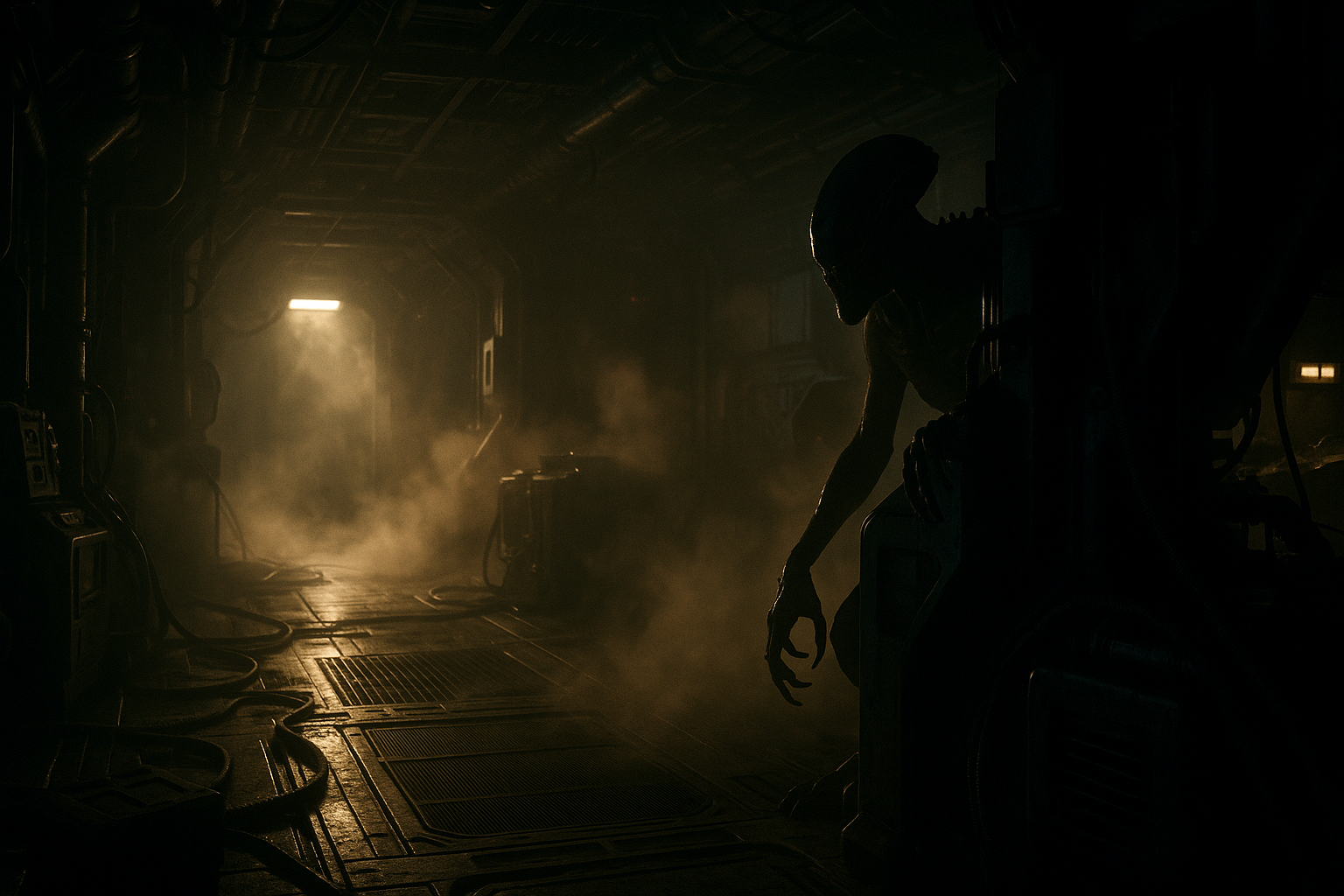
That difference in visibility shapes the experience. A visible creature creates immediate chase suspense: viewers study its speed, size, and method of attack. Suggestion-based horror keeps the threat unstable, allowing shadows, darkness, and the ship’s machinery to do part of the frightening work. The following films use both approaches while keeping the alien or organism central to the vessel-bound terror.
Alien (1979)
Ridley Scott’s Alien remains the essential example of a creature turning a commercial spacecraft into a hunting ground. The Nostromo’s crew is vulnerable because they are isolated, divided, and poorly prepared for an organism they do not understand. Its industrial corridors, ladders, storage areas, and confusing catwalks make pursuit feel three-dimensional. The film’s restraint is crucial: the creature is often suggested through movement, sound, and fragments before its full physical presence becomes unavoidable.
Aliens (1986)
James Cameron’s Aliens shifts from stalking horror toward sustained survival action without abandoning the terror of an enclosed vessel. The marines’ main vulnerability is overconfidence: military training and advanced weapons do not eliminate the danger of an enemy that can attack from ceilings, ducts, and dark rooms. The colony and landing craft provide different kinds of enclosed spaces, while communications and defensive systems repeatedly determine who can be protected and who can be cut off.
Pandorum (2009)
Pandorum combines amnesia, claustrophobia, and creature suspense aboard a vast generation ship. Its passengers are vulnerable not only to hostile beings but also to confusion about their own identities, responsibilities, and surroundings. The vessel’s enormous scale makes it feel less like a safe transport system than a derelict underground world, with maintenance routes and abandoned sections creating opportunities for ambush. The creatures are more visible than the threat in Alien, giving the film a harsher chase-oriented rhythm.
Life (2017)
Life follows an international space-station crew confronting an extraterrestrial organism whose intelligence and adaptability make ordinary safety procedures dangerous. The crew’s main weakness is their dependence on containment protocols: every door, glove, laboratory surface, and communication system can become part of the problem. The station’s modular design creates shifting barriers rather than true security, and the film builds suspense by showing enough of the organism to make its physical capabilities frightening while preserving uncertainty about what it will do next.
Europa Report (2013)
Europa Report uses a more restrained approach to unknown life. The crew of a scientific mission is vulnerable because discovery requires them to investigate conditions they cannot fully observe or predict. Found-footage-style recordings, delayed communication, restricted visibility, and the spacecraft’s limited compartments make small malfunctions feel ominous. Rather than treating the alien presence as a conventional monster, the film emphasizes incomplete information and the terrifying possibility that a carefully planned mission has entered an environment governed by unfamiliar rules.
Psychological, Cosmic, and Survival-Focused Picks
Not every effective spaceship horror movie needs a creature stalking the corridors. Some of the most unsettling films in the genre turn isolation, exhaustion, grief, and uncertainty into the primary threats. The vessel may be haunted, malfunctioning, or simply too far from help, while the crew’s attempts to understand what is happening gradually become another source of danger.
Solaris (1972): Grief in the Void
Andrei Tarkovsky’s Solaris is a slow-burn psychological science fiction film in which a troubled space station becomes the setting for an encounter with forces that challenge memory, identity, and guilt. Its horror is abstract rather than aggressive. The characters cannot easily determine whether what they see is an external phenomenon, a reflection of their own minds, or something beyond human understanding. Patient viewers will find it disturbing precisely because the film refuses simple explanations.
Event Horizon (1997): The Ship as a Haunted House
Event Horizon is the most overtly supernatural choice here. A rescue crew boards a vessel that has returned after disappearing, and the ship’s impossible history begins to affect everyone aboard. The film combines haunted-house imagery with cosmic uncertainty, claustrophobic corridors, and escalating psychological pressure. It becomes increasingly bleak and intense, making it a strong pick for viewers who want their spaceship horror movies to feel nightmarish and visually aggressive.
Sunshine (2007): Mission Pressure and Psychological Collapse
Danny Boyle’s Sunshine follows a crew on an extraordinarily dangerous mission to restore the Sun. Although it eventually moves toward more direct thriller territory, much of its tension comes from fatigue, isolation, malfunctioning equipment, and the moral consequences of risking a small group for the survival of humanity. The crew must make decisions with incomplete information, and every technical failure carries enormous emotional weight. It is both contemplative and action-oriented, with a steadily darkening atmosphere.
Europa Report (2013): Uncertainty Without Easy Answers
Europa Report uses a found-footage style to present a mission to Jupiter’s moon Europa. Its fear develops through limited communication, incomplete evidence, and the crew’s inability to know whether the mission has uncovered something dangerous. The restrained presentation makes the film a good choice for viewers who prefer realistic, slow-burn tension over spectacle. Here, technology provides information but not safety, and scientific discovery does not guarantee control.
High Life (2018): Bleak Isolation and Moral Pressure
Claire Denis’s High Life is an austere, disturbing film about prisoners sent on a deep-space mission. Its horror comes from confinement, exploitation, sexual violence, loneliness, and the ethical collapse encouraged by an institution that treats human beings as expendable. This is not a conventional survival adventure; it is bleak, uncomfortable, and deliberately opaque. The ship feels less like a vehicle than a sealed social experiment from which nobody can easily escape.
Across these films, the strongest fear does not always come from an identifiable enemy. It can emerge from ambiguity, exhaustion, grief, a failed system, or the realization that advanced technology cannot protect the people relying on it. The most memorable entries make the ship itself feel hostile—or unknowable—turning every corridor, control panel, and locked door into part of the threat.
How to Choose the Right Spaceship Horror Movie
The best spaceship horror movies do not all aim for the same kind of fear. If you want the clearest starting point, begin with Alien. It remains an ideal introduction to the form because the spacecraft is both a workplace and a trap, turning routine corridors, machinery, and limited escape routes into sources of tension. For a more psychologically severe experience, Event Horizon is a natural follow-up, while viewers who prefer relentless survival pressure may want one of the more action-focused entries on this list.
Choose your film by the feeling you want to carry into the viewing:
If you want claustrophobic creature horror
Look for a story built around an unknown organism, a confined crew, and the fear that any room may become unsafe. These films emphasize stalking, hiding, isolation, and the vulnerability of people who cannot simply leave the building. Expect stronger physical danger and, depending on the title, graphic gore. They are the best choice when you want the spaceship to feel like a maze with something hunting inside it.
If you prefer slow-burn cosmic dread
Choose a film that gives more attention to strange signals, distant forces, and the limits of human understanding than to constant attacks. The pacing may be deliberate, with unease accumulating through sound, darkness, and unanswered questions. This path suits viewers who enjoy bleak implications and atmosphere over frequent jump scares. The fear often comes from realizing that the crew may be confronting something they cannot explain or control.
If you want intense survival action
Prioritize fast-moving stories in which damaged systems, dwindling resources, or an immediate threat force the characters to keep making difficult choices. These movies usually provide more momentum and direct confrontation, though they can still be grim and violent. They are a strong option for viewers who want horror blended with urgency rather than extended mystery.
If psychological uncertainty is the appeal
Pick a movie that makes the crew’s perceptions, memories, or judgment difficult to trust. Such stories may leave key events open to interpretation and place anxiety ahead of spectacle. They often work best when watched without expecting every question to receive a neat answer. Check the film’s tone beforehand if bleakness or disturbing themes are a concern.
For a retro atmosphere, choose an older production with tactile sets, practical-looking technology, and a slower industrial rhythm. For modern realism, seek a film that emphasizes procedural details, believable equipment, and the physical strain of operating far from Earth. In either case, consider the pacing: a patient build can reward atmosphere-focused viewers but frustrate anyone seeking immediate scares.
That contrast is the defining appeal of the setting. A spaceship can be a workplace, lifeboat, laboratory, or prison, but it is always a sealed environment suspended in an indifferent void. Once this focused list has answered your spaceship-specific search, related science fiction horror can broaden the experience with stories set on planets, stations, and other unfamiliar frontiers.